


Sahola Installment Plans: An Expert Analysis

9 min read Updated Mar 13, 2026
Nour Ahmed Ibrahim
Nour Ahmed Ibrahim

Digital Finance Expert

Digital Finance Specialist focusing on mobile payments and fintech solutions in Egypt

Sahola, also known as Souhoola, offers a prominent consumer finance solution within Egypt's rapidly expanding credit market. Acquired by Banque Misr in 2022, this service allows consumers to purchase goods and services immediately while deferring payment through structured monthly installments. The primary beneficiaries are individuals seeking financial flexibility for significant purchases without immediate capital, such as electronics, furniture, or healthcare services. Merchants also benefit by receiving full payment upfront, which improves cash flow and reduces credit risk. Key considerations for any potential user involve a clear understanding of administrative fees, the total cost of financing, and the serious personal finance risks associated with over-indebtedness in a high-growth credit environment.

Understanding Sahola and the BNPL Landscape

The operational model of Sahola is straightforward. The company partners with a network of over 1,600 merchants across Egypt. When a customer makes a purchase, Sahola pays the merchant the full transaction amount instantly. The customer then enters into a repayment agreement directly with Sahola, paying back the financed amount in fixed monthly installments over a pre-agreed tenor, which can extend up to 60 months. This structure effectively separates the retail transaction from the financing arrangement, providing efficiency for both the seller and the buyer.

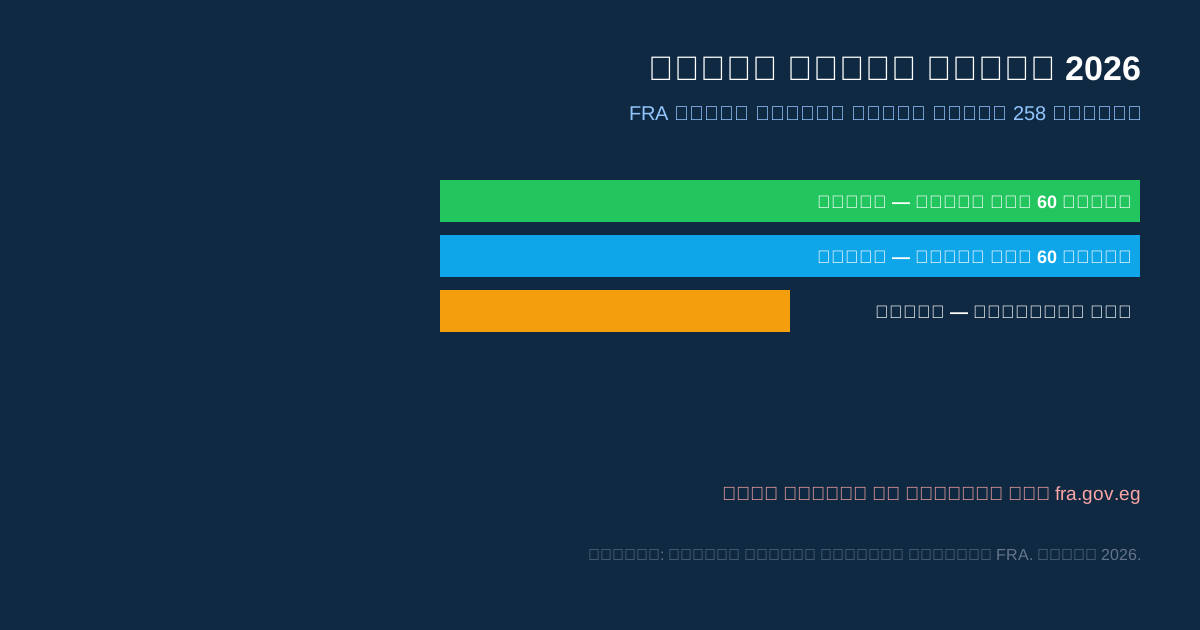
Sahola operates within the Buy Now, Pay Later (BNPL) sector, a segment of the non-banking financial services industry regulated by Egypt's Financial Regulatory Authority (FRA). The market is highly competitive, with 45 licensed consumer finance companies as of 2026. Key competitors include ValU, which holds a 25% market share, Contact Financial, the first company to receive a consumer finance license, and Aman. The acquisition by Banque Misr provides Sahola with significant institutional backing and capital, positioning it as a formidable player connected to one of the country's largest state-owned banks.

The regulatory framework, defined by Consumer Finance Law No. 18 of 2020, imposes specific obligations on providers like Sahola. Companies must offer minimum repayment periods of six months and provide customers with clear, standardized contracts. These contracts must disclose all applicable interest rates, administrative fees, and the total repayment amount before the agreement is signed. This regulation aims to protect consumers from predatory practices and ensure transparency in a market that has seen exponential growth.

EGP 56.7 Billion
Total consumer finance market size in Egypt (2026)
7 Million
Approximate number of active consumer finance clients
45
Licensed consumer finance companies operating under the FRA

Eligibility Criteria and Application Process

To qualify for installment financing, applicants must generally meet a standard set of criteria across the industry. The required age is typically between 21 and 60 years by the end of the financing period. Applicants need a valid Egyptian National ID card for verification. For foreign residents, a valid passport with a residency and work permit is necessary. While some fintech platforms offer more flexibility, many traditional lenders require a minimum monthly income, often starting around EGP 2,500. A critical factor is the applicant's credit history, which providers assess through the national credit bureau, I-Score.

Documentation requirements are standardized to comply with KYC (Know Your Customer) regulations. Applicants need to provide income verification, which can be an official HR letter stating their salary and tenure or recent salary slips. Six months of bank statements showing salary deposits are also commonly requested. For address verification, a recent utility bill is standard. Self-employed individuals must present a commercial registration, a valid tax card, and recent financial statements. This documentation allows the provider to assess an applicant's ability to manage monthly repayments.

The application process varies significantly between fintech providers and traditional banks. With Sahola and similar digital platforms, the process is streamlined. A customer typically downloads the mobile app, creates an account using their national ID, and completes the application online. Approval can be nearly instantaneous, often within minutes, as the system uses AI-driven algorithms to assess risk. In contrast, applying for a credit card installment plan at a bank might involve calling customer service or visiting a branch, with approvals taking 24 to 48 hours and enrollment processing within five working days.

Cost Analysis: Comparing Rates and Fees

Analyzing the total cost of installment financing requires looking beyond the advertised interest rate. Many providers, including Sahola, heavily promote 0% interest offers. While these plans do not charge interest, they almost always include administrative or processing fees that represent the actual cost of the credit. These fees are not standardized and can vary based on the merchant, the financed amount, and the repayment tenor. It is imperative for consumers to calculate the total amount they will repay, including all fees, to understand the true cost.

Traditional bank credit card installments present a different cost structure. For promotional 0% interest campaigns, the cost is often absorbed by the merchant partner. However, for standard installment plans on non-promotional purchases, banks charge a monthly interest rate on the decreasing balance. For example, CIB charges monthly rates ranging from 2.75% to 3.17%, depending on the tenor, in addition to a 2% administrative fee per transaction. Banque Misr applies a 3% monthly interest rate on its standard installment plans. These interest-bearing plans can become significantly more expensive than a fee-based BNPL product over a long tenor.

ProviderTypical TenorInterest Rate StructureKey Fees
Sahola (Banque Misr)6-60 monthsOften 0% (promotional)Administrative fees apply
CIB (Credit Card)6-36+ months2.75% - 3.17% monthly2% admin fee per transaction
NBE (Credit Card)6-24 monthsOften 0% (promotional)Commission varies by campaign
ValUUp to 60 months0% interest modelProcessing fees (risk-based)
Aman6-36 months0% interest modelAdministrative fees apply

Several regulations govern these terms. The FRA mandates that the total monthly installment payments for a borrower cannot exceed 50% of their total monthly income. This debt-to-income ratio is a safeguard against over-leveraging consumers. Penalties for late payments are also common, with some providers charging a fixed fee like EGP 150 for each missed month. Canceling an installment plan before maturity often incurs a penalty, such as 5% of the remaining principal, which discourages early repayment.

Market Dynamics and Regulatory Environment

The Egyptian consumer finance market is undergoing significant structural changes. In a move to ensure market stability, the FRA extended its suspension on issuing new licenses for traditional consumer finance companies through 2026. This decision is intended to prevent market oversaturation and protect the solvency of existing firms. A notable exception to this suspension is for companies utilizing financial technology. The regulator continues to grant licenses to fintech-driven startups to encourage digital transformation and financial inclusion.

In 2026 alone, the FRA licensed 16 new fintech companies, including consumer finance players Telda and Bokra. This dual approach—restricting traditional growth while promoting digital innovation—is reshaping the competitive landscape. It places established players like Sahola, which combines a digital platform with the backing of Banque Misr, in a strong position. The market's potential remains vast, with a penetration rate of only 3.9% of the population, indicating substantial room for growth as more Egyptians gain access to formal credit.

Economic factors also influence the market. In late 2026, the Central Bank of Egypt cut its key interest rates, lowering the overnight lending rate to 22%. Lower central bank rates reduce the cost of funding for consumer finance companies, which can translate into more competitive rates for consumers. This monetary policy supports the growth of the credit sector. Technology is another driver, with the widespread adoption of QR-code payments at over 1.2 million merchants and real-time fund transfers via the InstaPay network making digital lending more efficient and accessible.

Regulatory Update
The FRA has suspended new licenses for traditional consumer finance firms until 2026 to ensure market stability. However, licensing for fintech-based companies continues, signaling a strategic push towards digital financial services.

Risks and Responsible Usage

The rapid expansion of consumer credit in Egypt brings substantial risks for individuals. Easy access to BNPL services can lead to over-indebtedness, where consumers accumulate debt beyond their capacity to repay. Reports indicate a high default rate, with some sources suggesting as many as 60% of borrowers have struggled with loan repayment. The consequences of default are severe. They include late payment fees, significant damage to one's I-Score credit rating, and potential legal action from the lender.

A damaged I-Score can prevent an individual from accessing any form of credit—from car loans to mortgages—for several years. In more serious cases, unpaid debt can lead to legal proceedings in Egypt's Economic Courts. Before committing to an installment plan, a consumer must conduct a realistic assessment of their financial stability. A responsible approach involves limiting total monthly debt payments to well under the 50% legal cap, ideally below 30% of net income, and maintaining an emergency fund equivalent to three to six months of living expenses.

Advantages of Installment Plans

  • Enables large, necessary purchases
  • Fixed payments aid budget management
  • 0% interest offers can be cost-effective
  • On-time payments can build credit history

Considerations and Risks

  • High risk of over-indebtedness
  • Administrative fees represent a real cost
  • Default severely damages I-Score rating
  • Late fees and penalties can accumulate

Smart usage of installment services requires discipline. Consumers should reserve these products for essential, high-value goods that provide long-term utility, not for discretionary spending or lifestyle inflation. Whenever possible, selecting the shortest possible repayment tenor minimizes the overall financial burden and risk exposure. It is also wise to set up automatic payments from a bank account to avoid accidental late payments, which can trigger penalties and negative reporting to the credit bureau.

Sahola Versus Traditional Bank Installments

Choosing between a fintech provider like Sahola and a traditional bank's credit card installment plan involves distinct trade-offs. The primary advantage of Sahola and its BNPL peers is speed and accessibility. The application is entirely digital, and approval is often granted in minutes, making it highly convenient at the point of sale. This model also serves a broader demographic, including new-to-credit individuals or those who may not qualify for a high-limit credit card from a major bank.

Bank credit card installment plans, offered by institutions like CIB or NBE, cater to existing banking customers. While the application process is slower—requiring a phone call or online banking request after the purchase—banks often have the leverage to negotiate exclusive 0% interest promotions with a wider range of high-end retailers. For a consumer who already holds a credit card with a sufficient limit, using the bank's installment program can sometimes be more straightforward than registering for a new third-party service.

The decision ultimately depends on the consumer's financial profile and the specific purchase. An unbanked individual or someone with a limited credit history would find Sahola's digital-first, AI-driven assessment more accommodating. A financially established customer with a long-standing bank relationship may prefer the integrated experience and potentially better promotional terms offered by their bank. Both channels are regulated, but the user experience, approval criteria, and cost structures are fundamentally different, requiring careful comparison before making a commitment.

Share this article

Souhoola Consumer Finance Installment Guide

Souhoola is a consumer finance platform offering Buy Now Pay Later (BNPL) services that allows customers to purchase goods and services from partner stores and pay in installments over flexible periods.

Souhoola offers financing limits up to EGP 300,000, with specific amounts depending on the customer's eligibility and creditworthiness.

You primarily need your valid national ID card and a registered mobile number to apply for Souhoola financing.

Souhoola provides instant approval and allows instant origination of installment agreements through its mobile application and online platform.

Souhoola offers installment plans ranging from 3 to 60 months depending on the purchase amount and selected options.

Souhoola offers flexible payment options with optional down payment; you can choose plans with zero down payment or with a down payment according to your preference.

Administrative fees vary depending on the installment plan duration and are typically displayed at checkout; for example, some promotional offers include 0% interest with varying admin fees from 5% to 15% based on tenure.

Yes, you can download the Souhoola application or access the service through partner websites to apply online instantly with minimal documentation.

Souhoola (BM Consumer Finance) is owned by Banque Misr and operates under Central Bank of Egypt supervision as a non-banking financial institution.

Souhoola's parent company Banque Misr offers Islamic banking services through separate Islamic divisions; customers seeking Sharia-compliant financing should inquire about Islamic banking alternatives.

The minimum purchase amount to be eligible for Souhoola installments is typically EGP 1,000, though this may vary by merchant.

Souhoola services are available to both banked and non-banked individuals in Egypt who can provide a valid national ID and meet basic eligibility criteria.

Yes, Souhoola financing covers various categories including electronics, furniture, appliances, cars, health services, education, travel, and tourism through its network of over 1,600 partner outlets.

You can track your Souhoola payments and manage your account through the Souhoola mobile application, which provides real-time transaction updates and payment schedules.

In case of cancellation or returns, the refund will be reflected in your Souhoola account instantly; you can contact Souhoola customer service on 15227 for assistance.

Related Articles

HSBC Egypt: A 2026 Financial Analyst's Review & Guide

Explore HSBC Egypt's banking products, from Premier accounts to personal loans. This guide covers eligibility, fees, and key considerations for customers.

Jan 2, 2026

Minimum Age For Bank Account in Egypt: 2026 Guide

The minimum age for a bank account in Egypt is now 15. Explore our analysis of youth accounts, interest rates, and application requirements.

Jan 2, 2026

Abu Dhabi Islamic Bank (ADIB) Egypt: 2026 Financial Review

Explore Abu Dhabi Islamic Bank in Egypt. This guide covers ADIB's financial products, fees, and performance in the Egyptian market.

Jan 1, 2026

Mobile Installment in Egypt: A 2026 Financial Guide

Explore mobile installment options in Egypt. Compare interest rates, fees, and requirements from leading banks and BNPL providers like Valu to make informed financial decisions.

Jan 1, 2026