

Egypt's Best Savings Accounts: 2025 Analysis

10 min read Updated Mar 13, 2026
Nour Ahmed Ibrahim
Nour Ahmed Ibrahim

Digital Finance Expert

Digital Finance Specialist focusing on mobile payments and fintech solutions in Egypt

Egypt's banking sector offers some of the highest savings interest rates globally, making it an attractive environment for building capital. Savers seeking substantial returns on their Egyptian Pound (EGP) balances benefit most from this landscape. Key considerations for any potential depositor include the tiered interest rate structures, minimum balance requirements that unlock higher yields, and significant macroeconomic risks. Understanding the trade-offs between high nominal returns, persistent inflation, and potential currency devaluation is fundamental to making a sound financial decision. This guide provides a data-driven analysis to navigate these factors effectively.

Decoding Egypt's Savings Account Landscape

The Central Bank of Egypt (CBE) sets the monetary policy that directly influences savings account returns. As of November 2026, the CBE's overnight deposit rate is 21 percent, creating a high-yield environment where the average bank deposit interest rate reaches 16.8 percent. Banks in Egypt use a tiered system to calculate interest. Your return is determined by which balance bracket, or tier, your funds fall into. Higher balances earn progressively higher annual percentage yields.

Interest calculations typically depend on the lowest balance maintained in the account throughout a calendar month. This structure incentivizes savers to deposit funds early in the month and avoid withdrawals that could drop their balance into a lower-earning tier. Payouts vary by product, with banks offering monthly, quarterly, semi-annual, or annual distributions. Monthly payouts are particularly beneficial for savers who wish to leverage the power of compounding by reinvesting their earnings promptly.

The market contains a mix of state-owned giants, private-sector leaders, and Islamic financial institutions. State-owned entities like the National Bank of Egypt (NBE) and Banque Misr hold a significant market share. Private banks such as Commercial International Bank (CIB) and QNB Alahli provide competitive alternatives. For individuals seeking Sharia-compliant products, institutions like Faisal Islamic Bank of Egypt and Abu Dhabi Islamic Bank (ADIB) Egypt offer savings accounts structured around profit-sharing principles instead of fixed interest.

18.00%
Highest available tiered rate (AlexBank Ultra Saving)
16.8%
Average deposit interest rate in Egypt (Sept 2026)
21%
Central Bank of Egypt overnight deposit rate (Nov 2026)

Top High-Yield Savings Accounts Compared

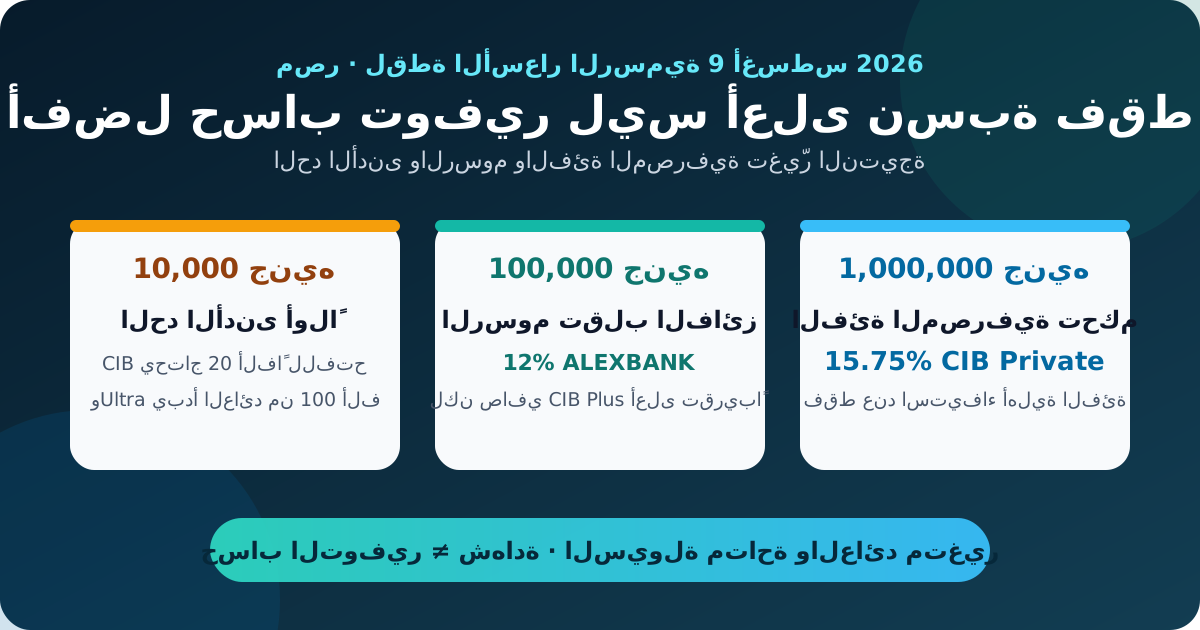
For savers with significant balances, several premium accounts offer market-leading returns. These products are structured to reward depositors who can meet higher minimum balance thresholds, often starting at EGP 100,000. Evaluating the specific tiers is important, as the highest advertised rate may only apply to balances exceeding several million EGP. The choice between them often depends on the saver's total deposit amount and preferred interest payout frequency.

Banque Misr’s Super Cash Saving Account provides a clear example of a tiered structure with monthly payouts. Its rates begin at 12.25% for balances between EGP 100,000 and EGP 500,000, rising sharply to 17.25% for balances above EGP 30 million. Bank of Alexandria's Ultra Saving Account is another strong contender. It offers 15.00% for balances starting at EGP 100,000 and reaches a peak of 18.00% for deposits over EGP 5 million. This account also features monthly interest payments, appealing to those focused on regular cash flow or compounding.

HSBC Egypt offers a more conservative EGP Savings Account with quarterly payouts. Its rates are significantly lower in the initial tiers, starting at just 0.25% for balances under EGP 10,000 and climbing to 8.00% for balances over EGP 5 million. While not the highest-yielding option for large deposits, its multi-currency features and international network appeal to expatriates and those managing finances across borders. The following table breaks down the rate structures of leading high-yield accounts.

Bank & Account NameBalance Tier (EGP)Annual Interest Rate (Monthly Payout)
Bank of Alexandria - Ultra Saving100,000 - 1M15.00%
Bank of Alexandria - Ultra Saving1M - 5M17.00%
Bank of Alexandria - Ultra SavingAbove 5M18.00%
Banque Misr - Super Cash100,000 - 500,00012.25%
Banque Misr - Super Cash500,000 - 2M15.25%
Banque Misr - Super Cash10M - 30M17.00%
Banque du Caire - Mega Saving50,000 - 999,99911.75%

Financial Inclusion and Specialized Accounts

Beyond premium products, Egyptian banks offer a range of accounts for smaller savers, youth, and those seeking Sharia-compliant returns. The CBE's financial inclusion initiatives have prompted banks to create accessible, low-fee products. These accounts remove common barriers to entry, such as high minimum deposits and monthly maintenance charges, making formal banking services available to a wider population. They serve as an excellent starting point for individuals beginning their savings journey.

Banque du Caire’s "Waffar" Saving Account is a primary example of a financial inclusion product. It offers a universal rate of 6% on balances from EGP 1 up to EGP 1,000,000. The account opening is free, has no minimum balance requirement, and charges no monthly maintenance fees. Similarly, Banque Misr's "Al Mongez" account provides tiered rates starting from balances as low as EGP 3,000, making it suitable for students and low-to-moderate income earners. These products are critical for fostering a culture of saving among the unbanked.

For those adhering to Islamic finance principles, banks like KFH Egypt and ADIB Egypt provide compliant alternatives. KFH Egypt's "My Daily Account" calculates profit daily on the closing balance and credits it monthly. This account requires a minimum opening deposit of EGP 5,000. ADIB Egypt also offers tiered monthly saving accounts with daily profit calculations. These accounts avoid fixed interest (riba) and instead operate on principles of shared risk and reward, aligning with Islamic law.

Waffar Saving Account
Institution
Banque du Caire
Key Feature
6% return, no minimum balance
My Daily Account
Institution
KFH Egypt
Key Feature
Sharia-compliant daily profit
Day by Day Account
Institution
Nasser Social Bank
Key Feature
15% return, EGP 500k minimum

Opening a savings account in Egypt is a standardized process, though requirements differ slightly for citizens and foreign nationals. Egyptian citizens typically need a valid national ID card, a recent utility bill as proof of address, and proof of income such as a salary slip or employment letter. As of November 2026, individuals aged 15 and older can open certain accounts without parental consent, a move intended to promote financial literacy among youth. For minors, a birth certificate is required in place of a national ID.

The process for foreign nationals is more document-intensive. Applicants need a valid passport with at least six months of validity and an entry visa or residency stamp. Banks also require proof of a local address, which can be a rental agreement or utility bill, and proof of employment. Some banks are more accustomed to handling applications from expatriates, with CIB and HSBC often cited as having more streamlined procedures for non-residents.

The standard application is completed in-person at a bank branch. The process takes between one to three business days if all documents are in order. For Egyptians living abroad, Banque Misr offers a remote service through Egyptian embassies. Applicants complete the forms at the consulate, which then authenticates the documents and forwards them to the bank. This service simplifies account opening for expatriates who wish to save or invest in their home country.

Advantages

  • Very high nominal interest rates
  • Tiered system rewards larger balances
  • Widespread digital and mobile banking
  • Strong financial inclusion products available

Considerations

  • High inflation erodes real returns
  • Risk of EGP currency devaluation
  • Deposit insurance fund not yet implemented
  • Strict KYC and source-of-funds checks

Critical Risks and Mitigation Strategies

While the high interest rates are attractive, savers must contend with significant macroeconomic risks. The Egyptian Pound has devalued by approximately 49% against the US dollar since early 2022. With 12-month forward rates trading above 40 EGP/USD compared to the current official rate near 31 EGP/USD, market expectations point toward potential further depreciation. This currency risk can erode the international purchasing power of savings held in EGP.

Inflation presents another major challenge. Although Egypt's inflation rate has decreased from its peak of over 40% in 2023, it remained at 12.5% in October 2026. With an average deposit rate of 16.8%, the real return for savers is a modest 4.3%. This narrow margin highlights that high nominal rates are partially a compensation for high inflation. Long-term wealth accumulation requires strategies that outperform inflation by a wider margin.

Institutional factors also warrant consideration. The banking sector is highly concentrated, with the top 10 banks holding nearly 78% of all deposits. A significant risk is the absence of a fully implemented statutory deposit insurance scheme. While the New Banking Law provides for a Guarantee of Deposits Fund (GDF), its operational rollout is incomplete. In a crisis, depositors would rely on the CBE's discretionary actions rather than a pre-defined insurance limit, creating uncertainty for large balances.

Important Warning: Currency and Deposit Risks
The Egyptian Pound (EGP) faces ongoing devaluation risk. Furthermore, Egypt's statutory Guarantee of Deposits Fund (GDF) is not yet fully implemented, meaning there is no explicit insurance limit protecting depositor funds. Diversification across multiple banks and currencies is a prudent risk management strategy.

To mitigate these risks, savers should adopt a diversified approach. Maintaining a portion of savings in foreign currency accounts (USD or EUR) can act as a hedge against EGP devaluation, though these accounts offer much lower returns. Spreading deposits across several different banks reduces institutional risk. For those looking to lock in current high rates before the CBE implements expected future rate cuts, moving a portion of funds into fixed-rate savings certificates or term deposits is a sound strategy.

Expert Recommendations for Different Savers

Your ideal savings strategy depends on your financial position and goals. For high-balance savers with over EGP 100,000, the primary focus should be on maximizing returns through premium tiered accounts. Banque Misr's Super Cash and Bank of Alexandria's Ultra Saving accounts are excellent choices. Savers in this category should aim to keep their balances comfortably within the highest possible tier to capitalize on rates of 15% to 18%. It is also wise to consider laddering funds into 1-to-3-year savings certificates to secure current high yields against future rate cuts.

Moderate-balance savers, with deposits between EGP 10,000 and EGP 50,000, must prioritize avoiding minimum balance penalties. Attempting to use a premium account is risky, as a small withdrawal could negate all interest earnings and incur fees. Instead, accounts like Banque Misr's Al Mongez, which offers over 10% interest for this range, are more suitable. Alternatively, Banque du Caire's Waffar account provides a stable 6% return with no minimums, making it a safe and flexible option for growing funds.

For youth, students, and individuals new to banking, financial inclusion products are the best starting point. The Waffar and Al Mongez accounts offer a fee-free way to build savings habits. Recent regulations allowing individuals aged 15-21 to open accounts without parental consent have further lowered barriers. The focus for this group should be on consistency and discipline rather than chasing the highest possible rate. Full access to mobile banking apps also helps build financial management skills early.

Expatriates and international investors face a unique set of challenges, primarily related to currency risk. A multi-currency portfolio is the most effective approach. Use a high-yield EGP account for local expenses and to benefit from the high interest rates. At the same time, hold a significant portion of savings in a USD or EUR account as a hedge against devaluation. The lower interest earned on foreign currency accounts should be viewed as the cost of this financial insurance.

Share this article

Egyptian Banks Savings Account Guide

Egyptian bank savings accounts offer tiered interest rates based on deposit levels, flexible interest payout frequencies (monthly, quarterly, semi-annually, or annually), debit card access, online banking, and multiple currency options (EGP, USD, EUR, GBP).

Interest rates vary significantly by bank and deposit tier. Major banks like Banque Misr offer rates from 8.75% to 11% for EGP accounts (updated December 2025), while SAIB offers up to 22% annual rates on Saytara Plus accounts, and BANK NXT offers rates up to 19.25% depending on balance levels.

Minimum opening balances range from EGP 500 to EGP 100,000 depending on the bank and account type. For example, KFH Egypt requires EGP 5,000, SAIB requires EGP 20,000, while Banque Misr's Al Mongez account accepts as low as EGP 100.

Required documents typically include a valid national ID or passport, proof of residency (utility bill or tenancy contract), and proof of employment (salary slip or employment letter). For foreigners, a valid residency visa is also required.

Fees include account opening (ranging from free to EGP 60), monthly/quarterly maintenance fees (typically EGP 16-100), minimum balance fall-below fees (EGP 30-125 if balance drops below threshold), and statement fees (often free for online statements).

Yes, most Egyptian banks offer online banking and mobile banking applications allowing 24/7 access to accounts, fund transfers, bill payments, balance checks, and transaction monitoring from digital channels and ATMs.

Yes, several banks offer Sharia-compliant savings accounts. Banque Misr provides Hewalty and Islamic Investment Saving Accounts, and KFH Egypt offers fully Sharia-compliant savings products reviewed by their Sharia Supervisory Board, all complying with Islamic principles and supervised by the Central Bank of Egypt.

Daily cash withdrawal limits from bank branches are currently EGP 250,000 for individuals. ATM withdrawals are typically limited to EGP 30,000 per day. These limits may be adjusted periodically by the Central Bank of Egypt.

Interest income received from local banks is not taxable for residents in Egypt, making savings accounts a tax-efficient investment option for local residents.

Tiered savings accounts offer higher interest rates for larger deposits. As you maintain higher balances, you move into higher tiers with better returns. For example, SAIB's Saytara Plus offers 16.75% on EGP 15,000-500,000 monthly payments, increasing to 20% on deposits over EGP 50 million.

Yes, the Central Bank of Egypt permits both resident and non-resident foreigners to open and maintain savings accounts in Egyptian banks, provided they meet KYC requirements and follow anti-money laundering regulations.

Interest is calculated on the lowest monthly balance and can be paid monthly, quarterly, semi-annually, or annually depending on the account type selected. Some accounts offer daily calculation with monthly crediting.

The process typically involves visiting a bank branch with required documents, completing a Know Your Customer (KYC) form, undergoing biometric verification, making an initial deposit, and account approval usually within 2-3 business days.

Yes, several banks offer youth savings accounts for individuals aged 15-25 with preferential rates and benefits. For example, HSBC offers a Youth Savings Account with preferential interest rates, and Bank of Alexandria offers youth accounts for ages 16-25.

Most savings accounts have no maximum balance limits, though some specialized accounts may have caps for interest calculation purposes. For example, Banque Misr's Al Mongez account has a maximum interest calculation cap of EGP 750,000.

Related Articles

HSBC Egypt: A 2026 Financial Analyst's Review & Guide

Explore HSBC Egypt's banking products, from Premier accounts to personal loans. This guide covers eligibility, fees, and key considerations for customers.

Jan 2, 2026

Minimum Age For Bank Account in Egypt: 2026 Guide

The minimum age for a bank account in Egypt is now 15. Explore our analysis of youth accounts, interest rates, and application requirements.

Jan 2, 2026

Abu Dhabi Islamic Bank (ADIB) Egypt: 2026 Financial Review

Explore Abu Dhabi Islamic Bank in Egypt. This guide covers ADIB's financial products, fees, and performance in the Egyptian market.

Jan 1, 2026

Mobile Installment in Egypt: A 2026 Financial Guide

Explore mobile installment options in Egypt. Compare interest rates, fees, and requirements from leading banks and BNPL providers like Valu to make informed financial decisions.

Jan 1, 2026