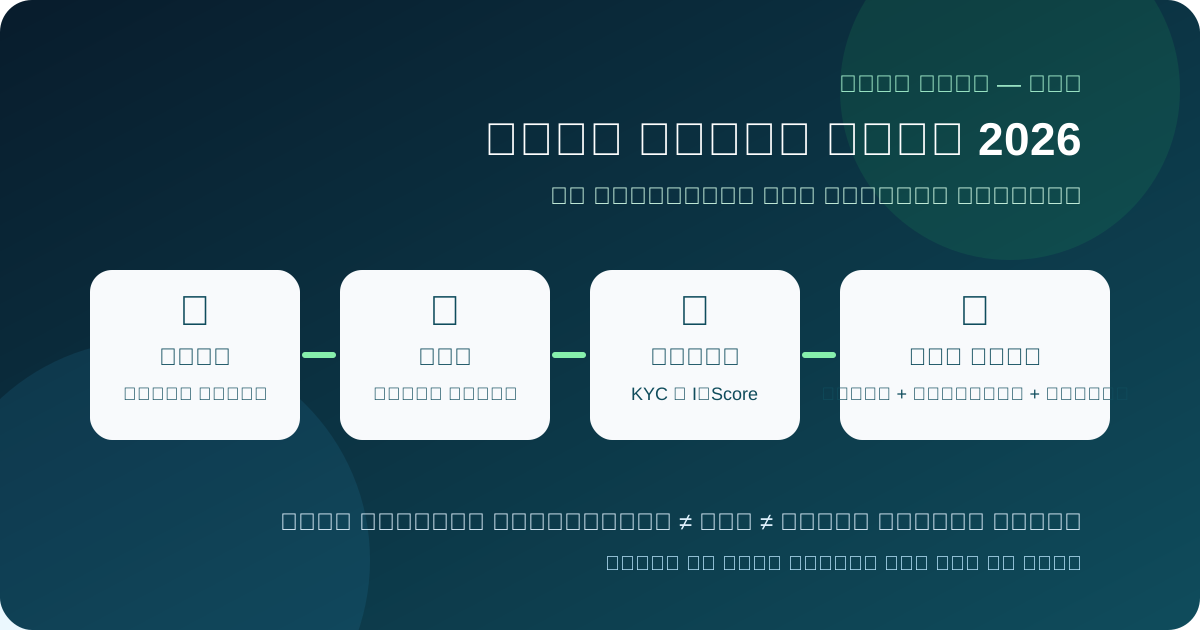


Aman Installment Requirements in Egypt

9 min read Updated Mar 13, 2026
Mohamed Hassan El-Sayed

Banking & Investment Expert

Senior Banking Advisor with 12+ years experience in Egyptian financial sector

The rise of consumer finance in Egypt presents new opportunities for acquiring goods and services through flexible payments. Aman for Financial Services, a key player in this sector, offers a regulated Buy Now, Pay Later (BNPL) model distinct from traditional bank loans. This system primarily benefits consumers who require immediate purchasing power without the stringent collateral requirements of conventional credit. Individuals seeking financing for electronics, furniture, or other durable goods find these platforms highly accessible. Key considerations before applying include a clear understanding of the fee structure, the impact on your credit history, and the regulatory oversight provided by Egypt's Financial Regulatory Authority (FRA), which governs these non-bank financial institutions.

EGP 5.6 Billion
Consumer Finance Issued in 2026
5,000+
Partnered Merchants Nationwide
150,000+
Point-of-Sale Terminals Deployed

Understanding the Aman Ecosystem

Aman operates as a licensed consumer finance company under its parent, Raya Holding, functioning within the legal framework established by Law No. 18 of 2020. This legislation specifically governs non-bank financial activities, creating a regulated space for BNPL providers. Aman’s business model revolves around providing installment plans for consumers at the point of sale, allowing them to make purchases immediately and pay over a set period, typically ranging from 6 to 36 months. This structure is fundamentally different from a personal loan, as the financing is tied directly to the purchase of a specific good or service from a partner merchant.

The operational backbone of Aman is its vast physical and digital network. With 253 branches across 23 governorates, the company maintains a significant ground presence. This is complemented by a digital infrastructure that includes over 150,000 point-of-sale (POS) terminals and the Aman Super App. This hybrid approach enables consumers to apply for and manage their installments either in person or through their mobile devices. The network of over 5,000 merchants ensures a wide selection of products and services are available for financing, from electronics retailers to healthcare providers.

Core Eligibility and Documentation Requirements

Securing an installment plan through Aman requires applicants to meet a set of standardized eligibility criteria. The typical age range for applicants is between 21 and 62 years. Applicants need to demonstrate a stable source of income, which can come from salaried employment, a pension, self-employment, or business ownership. While a specific minimum income is not always publicly stated and can vary, a baseline comparable to the EGP 2,500 often required for entry-level banking products is a reasonable expectation. A valid Egyptian national ID card is a mandatory document for identity verification.

The documentation process is central to the application and is mandated by Know Your Customer (KYC) regulations enforced by the FRA. For all applicants, a clear copy of a valid national ID is the first step. To verify income, salaried employees must provide a certified letter from their employer or recent salary slips. Pensioners can submit a pension statement, while business owners or self-employed individuals need to present documents like recent bank statements or business registration certificates. Finally, proof of address is required, typically in the form of a recent utility bill (electricity, water, gas) or a valid lease agreement in the applicant's name.

These requirements ensure compliance with anti-money laundering regulations and allow Aman to perform a credible risk assessment. The company uses this information, often in conjunction with a credit check from the national credit bureau (I-Score), to determine an applicant's creditworthiness and set an appropriate installment limit. Failure to provide complete or accurate documentation is the most common reason for application rejection or delays.

Application Process: A Step-by-Step Walkthrough

Aman provides three distinct channels for applying for an installment plan, each catering to different consumer preferences. The most direct digital method is through the Aman Super App. An applicant downloads the application, registers an account, and completes the KYC verification by uploading images of their national ID, proof of address, and income documents. After submission, Aman assesses the profile and assigns a pre-approved credit limit, often within 24 hours. The user can then use this limit to shop at any partner merchant.

For those who prefer face-to-face interaction, visiting one of Aman's 253 branches is another effective method. At the branch, a sales agent assists the applicant in completing the application form and verifies the original documents on the spot. This channel can be advantageous for complex applications or for individuals who need guidance through the process. The approval timeline is typically between 24 and 48 hours, with a confirmation sent via SMS to the applicant's registered phone number.

The third and most immediate application method occurs directly at a partner merchant's point of sale. When making a purchase, a customer can request to pay using Aman installments. The merchant's staff will conduct a quick verification process, usually requiring only the national ID. Upon successful verification and signing of the financing contract, the purchase is completed, and the payment is split into the chosen installment plan. This in-store process is optimized for speed and convenience, making it a popular choice for retail purchases.

Advantages of Aman Installments

  • Rapid approval, often within 24 hours
  • Minimal documentation compared to bank loans
  • Wide network of over 5,000 retailers
  • Frequent 0% interest promotional offers
  • Accessible to unbanked and underbanked segments
  • Digital management via Aman Super App

Considerations and Risks

  • Risk of over-indebtedness from easy credit access
  • Administrative fees may apply even on 0% offers
  • Missed payments negatively impact I-Score credit history
  • Standard interest rates can be higher than bank loans
  • Managing multiple installment plans can be complex
  • Default can lead to demand for full outstanding balance

Comparing Aman with Traditional Bank Installments

The Egyptian consumer finance market includes both fintech providers like Aman and traditional banks such as CIB, QNB Alahli, and Banque Misr. While both offer installment products, their structures, requirements, and target audiences differ significantly. Banks typically offer installments through credit cards or personal loans. Credit card installments, for example, allow existing cardholders to convert a purchase into a payment plan, often with 0% interest during promotional periods with partner merchants. This option is convenient for customers who already have a good credit history with the bank.

Personal loans from banks offer another path to financing but usually involve a more rigorous application process, higher income requirements, and potentially a salary transfer mandate. In contrast, fintech players like Aman and ValU provide direct point-of-sale financing that is not contingent on a pre-existing credit card relationship. Their approval process is generally faster and relies on a combination of KYC documents and proprietary risk assessment algorithms, making it more accessible to a broader segment of the population, including those with limited banking history.

The primary trade-off lies between accessibility and cost. While Aman's 0% interest promotions are attractive, their standard financing rates and administrative fees can sometimes be higher than the effective annual rates on a bank's personal loan. Consumers must carefully evaluate the total cost of financing, including all fees, rather than focusing solely on the monthly payment amount. The table below provides a comparative overview of typical offerings.

Provider / ProductTypical TenorInterest / FeesKey Feature
Aman Consumer Finance6-36 monthsVariable; frequent 0% promotional offersFast approval; wide merchant network
CIB Credit Card InstallmentUp to 36 months0% with partner merchants; fees may applyFor existing CIB credit cardholders
QNB Alahli Personal Finance6-84 monthsVaries by profile; typically 2.5-3% monthlyHigher loan amounts; longer tenors
Banque Misr Credit CardUp to 24 months0% during promotional events like White FridayBroad merchant acceptance
ValU BNPLUp to 60 monthsOften interest-free; plan fees may applyCovers sectors like healthcare & education

Rates, Fees, and Financial Commitments

Understanding the complete cost structure is necessary before entering any installment agreement. Aman, like other consumer finance companies, does not operate with a single, fixed interest rate. The cost of financing is dynamic and depends on several factors: the product category, the length of the installment plan, ongoing promotional campaigns, and the individual applicant's risk profile. During major sales events, it is common for Aman to partner with merchants to offer 0% interest plans for tenors up to 12 or even 24 months.

Outside of these promotional periods, financing costs are applied. Consumers should always inquire about the administrative fees, which can be a fixed amount or a percentage of the purchase price. These fees are charged to cover the cost of processing and managing the installment plan. According to FRA regulations, all fees and the total repayment amount must be clearly disclosed in a standardized contract before the customer signs. This transparency is a key consumer protection measure designed to prevent hidden charges.

The financial commitment extends beyond just making payments. Timely payments are reported to the I-Score credit bureau, and a consistent payment history can positively impact one's credit score. Conversely, late or missed payments will have a negative effect, potentially making it more difficult to obtain credit in the future. In cases of default, the financing agreement typically allows the company to demand immediate payment of the entire outstanding balance, underscoring the importance of responsible borrowing and careful budgeting.

The Egyptian consumer finance sector is undergoing significant regulatory evolution, driven by the Central Bank of Egypt (CBE) and the FRA. A key development in 2026 was the FRA's Decree No. 138, which raised the pre-approved consumer cash finance limit from EGP 10,000 to EGP 50,000. This change gives licensed companies like Aman more flexibility to offer small, pre-approved cash facilities to qualified clients. The decree also mandated a stronger push towards digital transformation, requiring companies to enhance their IT infrastructure and prioritize electronic payments over cash transactions.

Another significant move was the FRA's decision to extend the suspension on issuing new licenses for consumer finance and microfinance companies until 2026. The institution's stated goal is to ensure the financial soundness of the market and assess the debt burden on existing clients before allowing new players to enter. This measure is intended to promote stability and responsible lending practices among the currently licensed operators. It also highlights the regulator's focus on quality and sustainability over rapid, unchecked expansion.

These regulatory shifts directly impact consumers. The emphasis on digital payments enhances security and creates a clearer audit trail for transactions. The temporary halt on new licenses means consumers should be diligent in verifying that any provider they engage with is officially licensed by the FRA. Working with regulated entities like Aman ensures that consumers are protected by the provisions of Law No. 18 of 2020, which includes rights to transparent contracts, fair treatment, and formal dispute resolution channels.

Regulatory Update: License Suspension
As of October 2026, the FRA extended its suspension on issuing new consumer finance and microfinance licenses. This action aims to strengthen the existing market and protect consumers by preventing oversaturation. Applicants should always verify a provider's active FRA license before signing any agreement.

Share this article

Aman Installment Service Requirements & Eligibility Guide

Applicants must generally be between 21 and 60 years old (up to 62 in some cases), hold a valid Egyptian National ID, and provide proof of stable income.

A bank account is not strictly required to apply, but having one helps for income verification; you can pay installments via the Aman app, Aman stores, or linked bank cards.

Typically, you need a valid National ID, a recent utility bill (gas, electricity, or water), and proof of income such as an HR letter or bank statement.

Students and housewives may be eligible if they provide a guarantor with steady income or proof of assets, though specific approval depends on the credit assessment.

Yes, you can apply directly through the Aman Super App by uploading your documents, with approval often granted within 24 hours.

Yes, administrative fees apply when activating a limit or making a purchase, and the exact percentage varies based on the chosen plan and promo offers.

Aman operates under civil consumer finance laws; while some 'interest-free' offers exist, clients seeking strict Sharia compliance should inquire directly about specific product structures.

Installment plans typically range from 6 months up to 36 months, depending on the merchant and the product category.

Yes, late payment fees are applied to overdue installments; it is recommended to pay on time to avoid additional charges and negative credit scoring.

Early settlement is generally permitted, though it is usually subject to an early settlement fee calculated on the remaining principal amount.

Currency rates can be viewed in the exchange rates section on this portal; Aman installments are typically processed in Egyptian Pounds (EGP).

Yes, Aman is licensed by the Financial Regulatory Authority (FRA) and operates in compliance with relevant consumer finance regulations monitored by Egyptian financial authorities.

You will likely need to provide additional proof of income, such as a bank statement showing regular deposits, or apply with a guarantor who meets the employment requirements.

Related Articles

HSBC Egypt: A 2026 Financial Analyst's Review & Guide

Explore HSBC Egypt's banking products, from Premier accounts to personal loans. This guide covers eligibility, fees, and key considerations for customers.

Jan 2, 2026

Minimum Age For Bank Account in Egypt: 2026 Guide

The minimum age for a bank account in Egypt is now 15. Explore our analysis of youth accounts, interest rates, and application requirements.

Jan 2, 2026

Abu Dhabi Islamic Bank (ADIB) Egypt: 2026 Financial Review

Explore Abu Dhabi Islamic Bank in Egypt. This guide covers ADIB's financial products, fees, and performance in the Egyptian market.

Jan 1, 2026

Mobile Installment in Egypt: A 2026 Financial Guide

Explore mobile installment options in Egypt. Compare interest rates, fees, and requirements from leading banks and BNPL providers like Valu to make informed financial decisions.

Jan 1, 2026